

Accueil / EXPOSITION : REGARDS, OMBRES ET LUMIÈRES
EXPOSITION : REGARDS, OMBRES ET LUMIÈRES
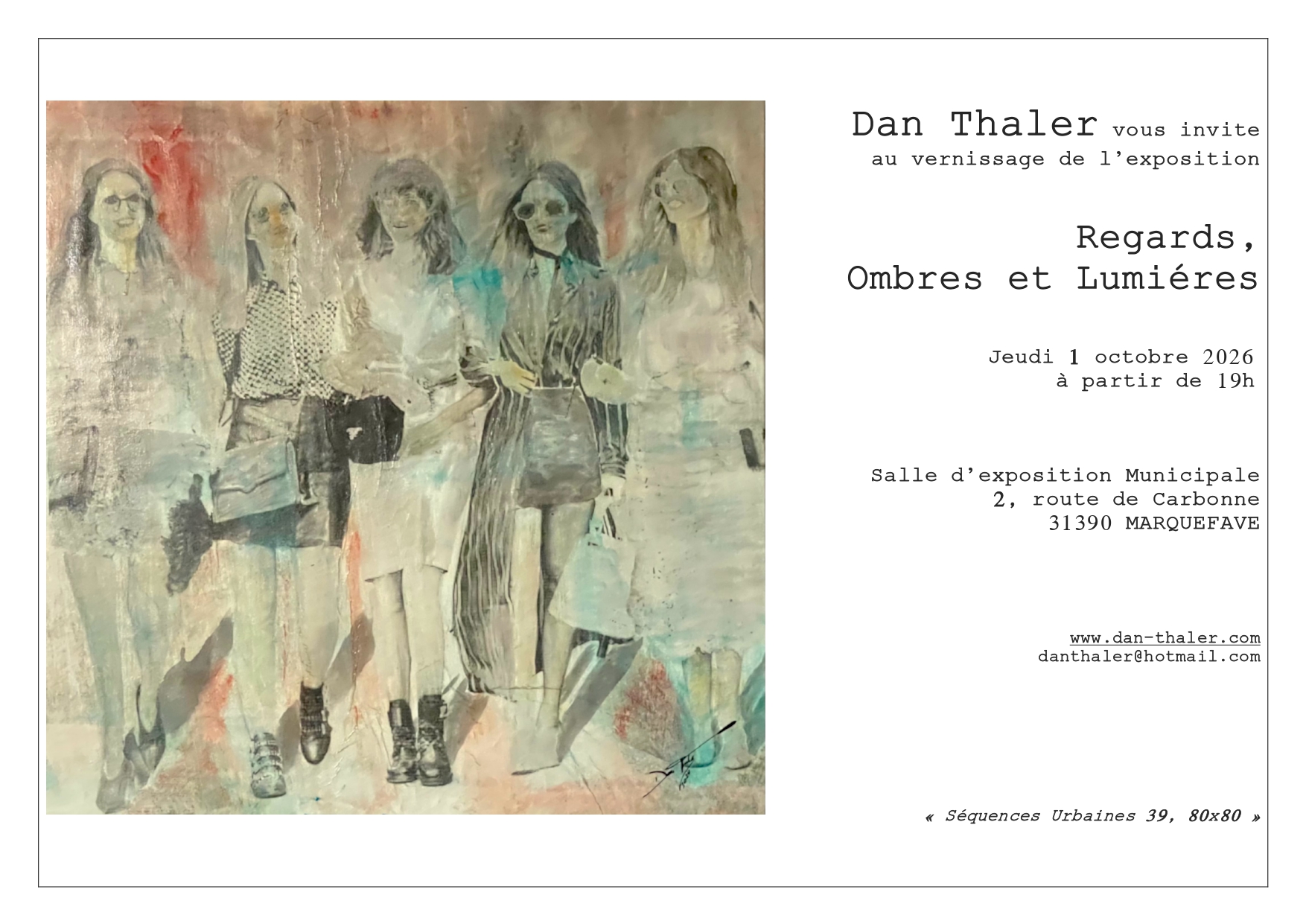
Come and discover Dan Thaler’s exhibition “Regards, Shadows and Light” in Marquefave!
An exhibition organised by Dan Thaler, in partnership with Marquefave Town Hall.
Marquefave’s new exhibition for October will be dedicated to painting; it will feature the painter Dan Thaler from 29 September to 29 October. The opening is scheduled for 1 October from 7.00 pm; this will be an opportunity to chat and share your thoughts on this series of paintings entitled ‘Urban Sequences’.
The series of paintings entitled “Urban Sequences” comprises three distinct groups: figurative, abstract and blurred. The aim of this exhibition is to focus exclusively on the series ‘Urban Sequences: Crowds, Shadows and Light – Series W’, which illustrates the evolution of Dan Thaler’s painting style, from the figurative to the abstract.
The city, the street, and the events that unfold there inspire the artist. Scenes featuring figures – most often women – are depicted as they go about their business, walking, chatting, observing, strolling… The city challenges, fascinates, bewitches, enchants, captivates, seduces and charms, but it also repels, rejects, excludes and abandons… Imbued with this environment, the ‘Séquences urbaines’ series draws on emotions, sensations, reflections and thoughts, as well as reading.
In this exhibition, the images are neither figurative nor abstract: the use of blurring has made it possible to move from a clear perception to scenes that are increasingly implied, where sharpness fades away. The technique is specific and unique to this series. The figures are painted in grey and black, using acrylic or oil on canvas. Once the canvas is dry, the artist then glues a sheet of Wenzouh paper (a very lightweight Chinese paper, hence the series’ name) over the entire surface. The painted forms disappear; then, by working over them with oil paint thinned with rectified turpentine, the background reappears as a translucent layer. This technique creates a distinct sense of mattness and depth.
Dan Thaler often depicts women in his street scenes, paying tribute to their courage whilst emphasising their humanity and beauty. The plight of women is brought to the fore. Despite all their struggles, they still face many difficulties in achieving the same level of equality as men. In economic and political life, as well as in the private sphere, inequality and harassment are rife. They are particularly evident on the streets and in public spaces. Harassment, rape and murder make the headlines, but how many women fail to report such incidents or speak out? How can we understand the city, feel its pulse, and grasp its bustling, hive-like nature?
Peaceful spaces, density, crowded, bustling streets in constant motion, with their processional crossings at zebra crossings, automatically halted and tirelessly restarted. Exchanges of glances, fleeting interactions, a shared atmosphere, complicity or incomprehension. Anonymous spaces allow for various modes of communication.
Amidst the throng, people go about their business, and in the detail of these actions one can observe the play of light and shadow. The crowd, and the question of light and shadow, inspired the philosopher W. Benjamin, the psychologist C.G. Jung, the writers E. Poe and Zweig, and the poet Ch. Baudelaire. Edgar Allan Poe, ‘The Man of the Crowd’: ‘My observations at first took an abstract and generalising turn. I regarded the passers-by in masses, and my mind considered them only in their collective relationships. Soon, however, I delved into the details and examined with meticulous interest the countless varieties of figures, attire, gaits, faces and facial expressions. ’ Or again, Charles Baudelaire, *The Crowds*: ‘It is not given to everyone to bathe in the multitude: to enjoy the crowd is an art, and only he who, at the expense of mankind, can feast on vitality—he into whose cradle a fairy has breathed a taste for disguise and masks, a hatred of home and a passion for travel—can do so. Multitude, solitude: terms that are equal and interchangeable…’.
Ideas arise from this dichotomy: danger accompanies power just as a shadow accompanies light. And the shadow exists only because there is light: the shadow is like the child of light. The psychologist C.G. Jung offers another perspective. The shadow is a part of the psyche formed by the individual aspect that is unaware of itself.
The question of the shadow gives rise to various approaches; one thing is certain: beauty is merely the shadow heralding the light. Khalil Gibran writes: ‘Beauty is a gentle whisper. It speaks within our minds. Its voice yields to our silences like a faint light trembling with fear before the shadow.”
Dan Thaler is fascinated by the interplay of light and shadow. He captures them in great detail within public spaces. The ‘Urban Sequences’ series provides an opportunity to express emotions gathered during his travels across different countries. In his paintings, he highlights beauty and mass phenomena, but also the solitude, attraction and repulsion generated by the city and the crowd. He explores the question of urbanity.
The series of paintings entitled “Urban Sequences” comprises three distinct groups: figurative, abstract and blurred. The aim of this exhibition is to focus exclusively on the series ‘Urban Sequences: Crowds, Shadows and Light – Series W’, which illustrates the evolution of Dan Thaler’s painting style, from the figurative to the abstract.
The city, the street, and the events that unfold there inspire the artist. Scenes featuring figures – most often women – are depicted as they go about their business, walking, chatting, observing, strolling… The city challenges, fascinates, bewitches, enchants, captivates, seduces and charms, but it also repels, rejects, excludes and abandons… Imbued with this environment, the ‘Séquences urbaines’ series draws on emotions, sensations, reflections and thoughts, as well as reading.
In this exhibition, the images are neither figurative nor abstract: the use of blurring has made it possible to move from a clear perception to scenes that are increasingly implied, where sharpness fades away. The technique is specific and unique to this series. The figures are painted in grey and black, using acrylic or oil on canvas. Once the canvas is dry, the artist then glues a sheet of Wenzouh paper (a very lightweight Chinese paper, hence the series’ name) over the entire surface. The painted forms disappear; then, by working over them with oil paint thinned with rectified turpentine, the background reappears as a translucent layer. This technique creates a distinct sense of mattness and depth.
Dan Thaler often depicts women in his street scenes, paying tribute to their courage whilst emphasising their humanity and beauty. The plight of women is brought to the fore. Despite all their struggles, they still face many difficulties in achieving the same level of equality as men. In economic and political life, as well as in the private sphere, inequality and harassment are rife. They are particularly evident on the streets and in public spaces. Harassment, rape and murder make the headlines, but how many women fail to report such incidents or speak out? How can we understand the city, feel its pulse, and grasp its bustling, hive-like nature?
Peaceful spaces, density, crowded, bustling streets in constant motion, with their processional crossings at zebra crossings, automatically halted and tirelessly restarted. Exchanges of glances, fleeting interactions, a shared atmosphere, complicity or incomprehension. Anonymous spaces allow for various modes of communication.
Amidst the throng, people go about their business, and in the detail of these actions one can observe the play of light and shadow. The crowd, and the question of light and shadow, inspired the philosopher W. Benjamin, the psychologist C.G. Jung, the writers E. Poe and Zweig, and the poet Ch. Baudelaire. Edgar Allan Poe, ‘The Man of the Crowd’: ‘My observations at first took an abstract and generalising turn. I regarded the passers-by in masses, and my mind considered them only in their collective relationships. Soon, however, I delved into the details and examined with meticulous interest the countless varieties of figures, attire, gaits, faces and facial expressions. ’ Or again, Charles Baudelaire, *The Crowds*: ‘It is not given to everyone to bathe in the multitude: to enjoy the crowd is an art, and only he who, at the expense of mankind, can feast on vitality—he into whose cradle a fairy has breathed a taste for disguise and masks, a hatred of home and a passion for travel—can do so. Multitude, solitude: terms that are equal and interchangeable…’.
Ideas arise from this dichotomy: danger accompanies power just as a shadow accompanies light. And the shadow exists only because there is light: the shadow is like the child of light. The psychologist C.G. Jung offers another perspective. The shadow is a part of the psyche formed by the individual aspect that is unaware of itself.
The question of the shadow gives rise to various approaches; one thing is certain: beauty is merely the shadow heralding the light. Khalil Gibran writes: ‘Beauty is a gentle whisper. It speaks within our minds. Its voice yields to our silences like a faint light trembling with fear before the shadow.”
Dan Thaler is fascinated by the interplay of light and shadow. He captures them in great detail within public spaces. The ‘Urban Sequences’ series provides an opportunity to express emotions gathered during his travels across different countries. In his paintings, he highlights beauty and mass phenomena, but also the solitude, attraction and repulsion generated by the city and the crowd. He explores the question of urbanity.
+ d'infos
- Exhibition, Meeting people
- Painting
- Cultural
Localisation
EXPOSITION : REGARDS, OMBRES ET LUMIÈRES
SALLE D'EXPOSITION
2 Route de Carbonne
31390 MARQUEFAVE
2 Route de Carbonne
31390 MARQUEFAVE
Du 29/09/2026 au 29/10/2026